How Many 8-Pound Bass Become 13-Pound Giants? What the Science Says
How rare is it for an already-big largemouth bass to become a true giant? A study published October 7, 2025 in the North American Journal of Fisheries Management tried to answer that question using angler-reported trophy-bass catches. The results help put just how difficult it is for a bass to progress from roughly 8 pounds to truly exceptional weights into perspective. For broader age-and-size context, see our guide to largemouth bass growth rates.
The study, Estimating recruitment of Largemouth Bass to exceptional weights using angler-reported catches, was authored by Leandro E. Miranda, Frank Griffin, Natalie Goldstrohm, J. Wesley Neal and Thomas J. Lang. Researchers examined what happened after largemouth bass reached 3.6 kg — about 7.9 pounds — and looked for environmental and genetic factors associated with more fish reaching even heavier weight classes.
The study in 30 seconds
Starting point: Bass that had already reached about 7.9 pounds.
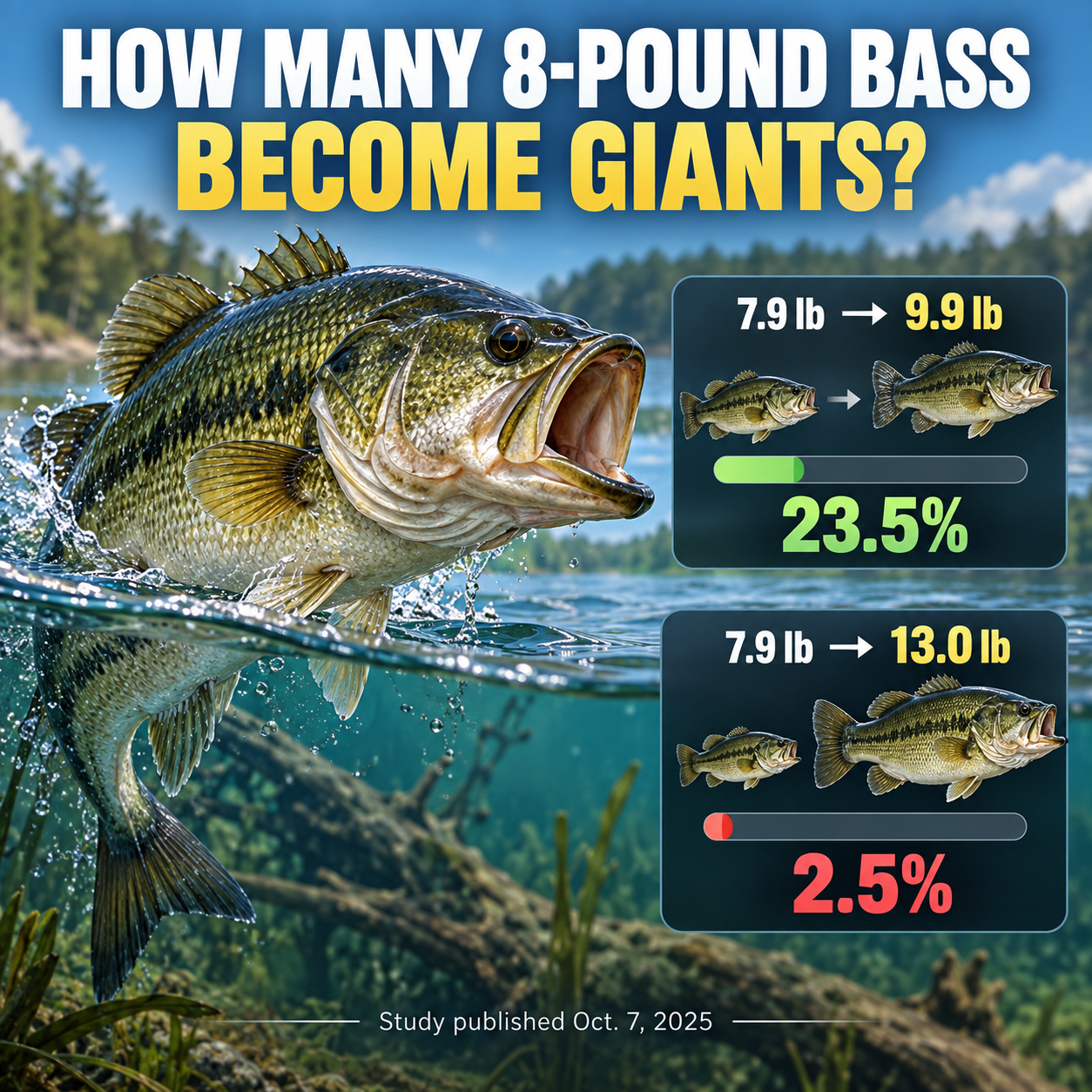
To about 9.9 pounds: The estimated recruitment averaged 23.5%.
To about 13.0 pounds: The estimated recruitment averaged just 2.5%.
Associated with more exceptional fish: A higher frequency of Florida Bass alleles.
Associated with fewer exceptional fish: Higher human population density near the reservoir and higher chlorophyll-a concentrations.
First: what does “recruitment” mean here?
This is important because the percentages can easily be misunderstood. The researchers were not following individual 7.9-pound bass and calculating each fish’s personal probability of becoming a 13-pounder. Instead, they developed a population-level index using the distribution of angler-reported catches at progressively heavier weights.
So the 2.5% figure should not be read as “an 8-pound bass has a 2.5% chance of becoming 13 pounds.” A better way to say it is that, across the fisheries represented in the data, the estimated recruitment from the 3.6-kg class to the 5.9-kg class averaged 2.5%.
Why the drop from 8 pounds to 13 pounds matters
A bass that has already reached roughly 8 pounds has cleared a lot of hurdles. It has survived predation, disease, angling pressure, environmental stress and years of seasonal changes while finding enough food to continue growing. The study suggests that moving from “big” to “exceptional” is another much narrower bottleneck.
The researchers reported an average recruitment estimate of about 20% after bass reached the 3.6-kg lunker threshold, but that varied widely among fisheries. When the weight classes were expanded, the estimated progression to about 9.9 pounds averaged 23.5%, while progression all the way to about 13 pounds averaged only 2.5%.
Florida Bass genetics stood out
One of the clearest positive relationships in the study was genetics. Recruitment to exceptional weights increased as the frequency of Florida Bass alleles increased in a population.
That finding fits the long-running use of Florida Bass genetics in trophy-bass management, particularly in Texas. It does not mean that genetics alone create giant bass. The researchers’ conclusion was essentially the opposite: exceptional size appears to require a balance of genetics, environment and survival.
The surprising human-population finding
Perhaps the most interesting result for anglers was the relationship with people. The study found that recruitment to heavier weight classes was negatively correlated with human population density around the reservoir. In other words, fisheries surrounded by denser human populations tended to show lower recruitment of already-large bass into exceptional weight classes.
The study did not prove that any one human activity caused the difference. The researchers did not isolate fishing pressure, harvest, boat traffic, shoreline development or handling mortality and show that one of those variables was responsible.
However, the U.S. Geological Survey’s explanation of the work interprets the result as being consistent with lower mortality in reservoirs near smaller human populations. That makes intuitive sense: a remote fishery may expose a trophy bass to fewer total encounters and fewer human-related risks over the many years required to reach exceptional size.
What the human-population result does — and does not — tell us
The study supports: Higher nearby human population density was associated with lower recruitment to exceptional weights.
The study does not prove: That urban reservoirs cannot grow giant bass, or that fishing pressure, harvest, handling, boating or development individually caused the relationship.
Our takeaway: Survival long enough to become exceptional may be just as important as growth potential. Remote fisheries may provide some large bass with a better chance to survive the final years needed to reach truly rare weights.
What about chlorophyll-a?
The researchers also found a negative relationship between recruitment and chlorophyll-a concentration, which is commonly used as an indicator of algae abundance and the trophic — or productivity — state of a reservoir.
This does not mean that low-productivity lakes automatically grow the biggest bass. Bass still need adequate forage and productive habitat. The authors described the apparent requirement as a balance: enough productivity and food to support growth, but not an excessively high trophic state.
Several things were not strongly associated with exceptional recruitment
The USGS summary of the research notes that recruitment to lunker sizes was not strongly associated with several variables that anglers might expect to matter, including reservoir age, reservoir area or depth, stocking density, and length limits.
That does not mean those factors never matter for a bass fishery. It means they were not among the variables that showed a strong relationship with this particular measure of recruitment from already-large bass to exceptional weights.
Why angler data mattered
Truly large bass are difficult to study with traditional fisheries sampling because they are rare. USGS highlighted the scale of that problem in Texas: conventional electrofishing surveys can collect tens of thousands of bass while encountering only a tiny number of fish above 8 pounds. Angler-reported trophy catches create a much larger sample of the upper end of the size distribution.
That makes programs such as Texas’ ShareLunker database unusually valuable for questions specifically about giant bass. Angler data have their own biases, but they can reveal patterns that would be nearly impossible to study using standard sampling alone.
Our take: giant bass require three things to line up
The simplest way we would explain this study is that producing a truly exceptional largemouth appears to require three broad ingredients:
1. Growth potential. Florida Bass genetics were positively associated with exceptional recruitment.
2. The right environment. Reservoir productivity appears to need to land in a productive-but-not-excessive range.
3. Time and survival. A fish can have excellent genetics and abundant forage, but it still has to survive long enough to express that potential. The negative relationship with surrounding human population density may be one clue that survival becomes increasingly important at the upper end of the weight distribution.
That final point may be the most interesting of all. Growing an 8-pound bass is difficult. Turning that fish into a 13-pounder may require not only exceptional growth, but several additional years in which almost everything continues to go right.
Read the original research
The study was published October 7, 2025 in the North American Journal of Fisheries Management, Volume 45, Issue 6, pages 1001–1011.
USGS publication page: Estimating recruitment of Largemouth Bass to exceptional weights using angler-reported catches
USGS explanation: Texas Anglers Unite to Fill Knowledge Gaps on Black Bass
Journal article / DOI: 10.1093/najfmt/vqaf082
Bass Fishing Facts note: This article is an explanatory summary of the published research. Statements identified as our take or interpretation are intended to help anglers understand the findings and should not be confused with conclusions directly tested by the study.